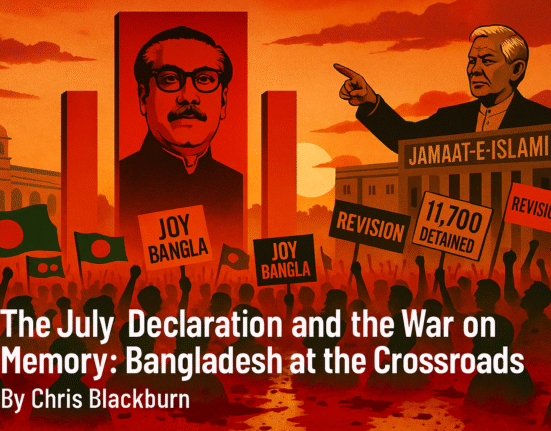

The interim government of Muhammad Yunus is sinking under the weight of its own contradictions. Once hailed by foreign observers as a corrective to Sheikh Hasina’s authoritarian drift, Yunus has embraced the very tactics of repression he claimed to abhor. The arrests of former minister Abdul Latif Siddiqui, Dhaka University Professor Sheikh Hafizur Rahman Karzon, and fourteen others under the Anti-Terrorism Act mark not a moment of reform, but of regression.
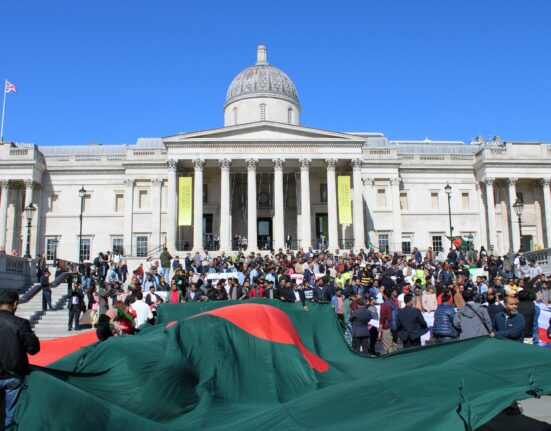
The so-called “Monsoon Uprising”—initially framed as a moment for renewal in the streets—has turned into a washout. Instead of energising the public or laying the foundations for democratic reform, Yunus has turned riot police on student protestors, journalists, and political organisers. In the last fortnight alone, we have witnessed attacks on demonstrators, the brutal treatment of students, and even the assault on Nurul Haque Nur, a figure whose own politics divide opinion but whose right to speak and protest should be beyond question.
International Condemnation
Yunus’s heavy-handed campaign has not gone unnoticed. In March, a coalition of global human rights organisations—including Human Rights Watch, Amnesty International, the Committee to Protect Journalists, and Fortify Rights—wrote directly to him. Their joint letter condemned attacks on the press, citing the harassment, intimidation, and arbitrary detention of journalists as unacceptable in any political transition. Rather than take heed, Yunus has doubled down, broadening his targets to opposition activists and critical academics.
Professor Karzon’s defiant appearance in court underscored how the Yunus administration is trampling constitutional protections. He accused the state of fabricating charges and demanded Tk 5 crore in compensation for violations of his rights. His case, like Siddiqui’s, illustrates the absurdity of wielding counter-terrorism legislation against elderly politicians and scholars whose supposed crime was attending a roundtable discussion.
From Promise to Peril
The tragedy of Yunus’s interim government is how quickly its image has curdled. Where there was once talk of healing the country after the fall of Hasina, there is now only deepening mistrust. The Monsoon Uprising—instead of inaugurating a new season of accountability—has collapsed into another story of repression, police violence, and hollow rhetoric.
For students and activists who filled the streets, the sense of betrayal is palpable. They demanded structural reforms, even a constitutional referendum. Instead, they are being beaten, surveilled, and dragged into court under laws that should never be used in a democratic transition.
A Washout with Consequences
The washout of the Monsoon Uprising leaves Yunus dangerously exposed. His campaign of repression has already alienated civil society at home and eroded his legitimacy abroad. The global rights community has issued its warning. Journalists and academics are sounding the alarm. Even sympathetic international voices now question whether Yunus’s Bangladesh is any less authoritarian than Hasina’s.
The lesson is stark: without reform, repression fills the vacuum. Yunus’s interim administration was supposed to chart a new path between fear and hope. Instead, it has chosen fear—and the rains of the monsoon have washed away the promise.