
Introduction: A Nation in Crisis
In Bangladesh, fear and uncertainty grip the nation. The Monsoon Uprising, a wave of protests that toppled the Awami League government in August 2024, has spiralled into chaos, marked by mob violence, revenge killings, and a surge in extremist influence. Jamaat-e-Islami, a radical Islamist political movement long accused of fostering extremism, has recently gained significant ground, with its student wing securing a victory in the Dhaka University Central Students’ Union (DACSU) election and making massive gains in the Jagannath University Central Students’ Union (JACSU) elections. These wins signal a troubling shift in institutions once considered strongholds of secular student politics.
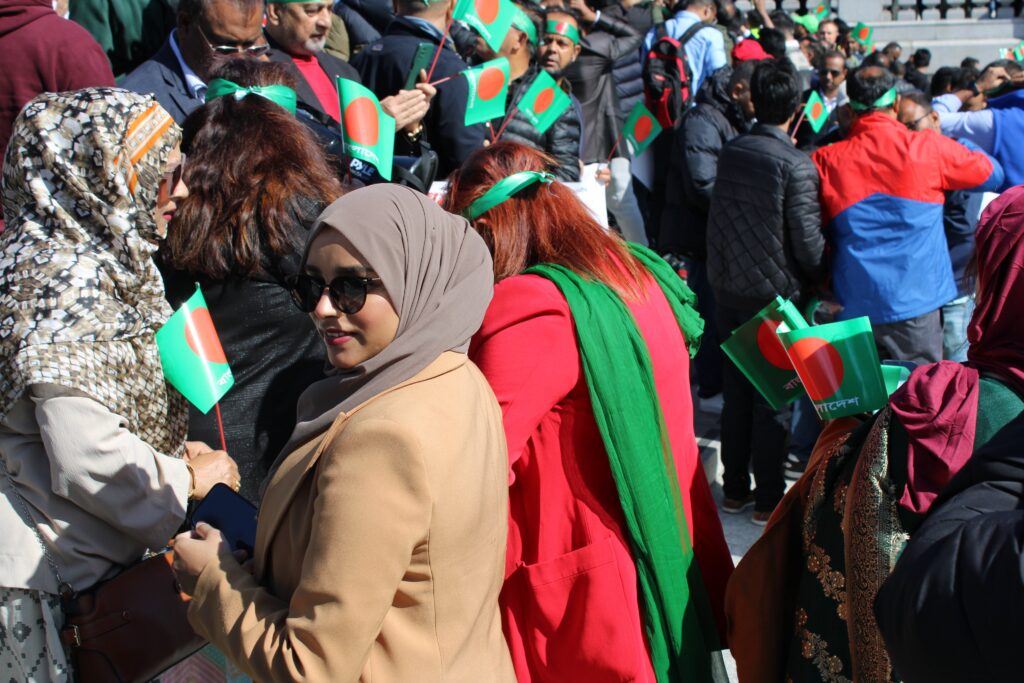
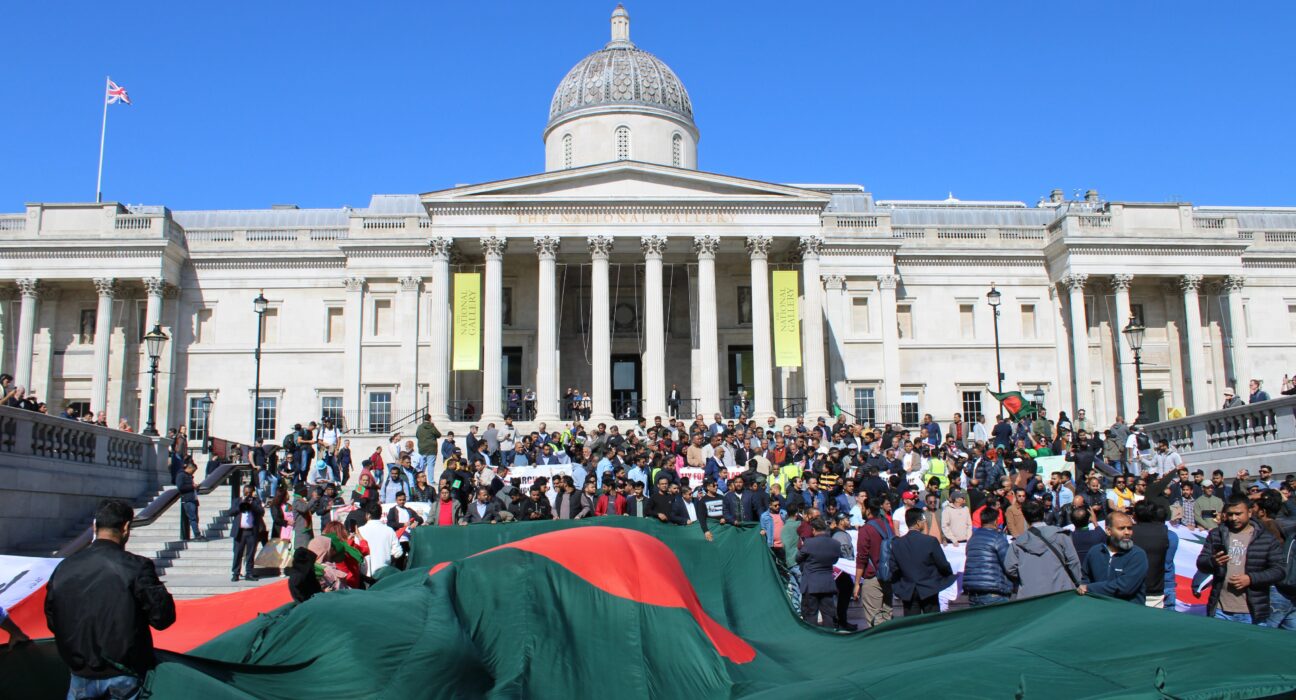
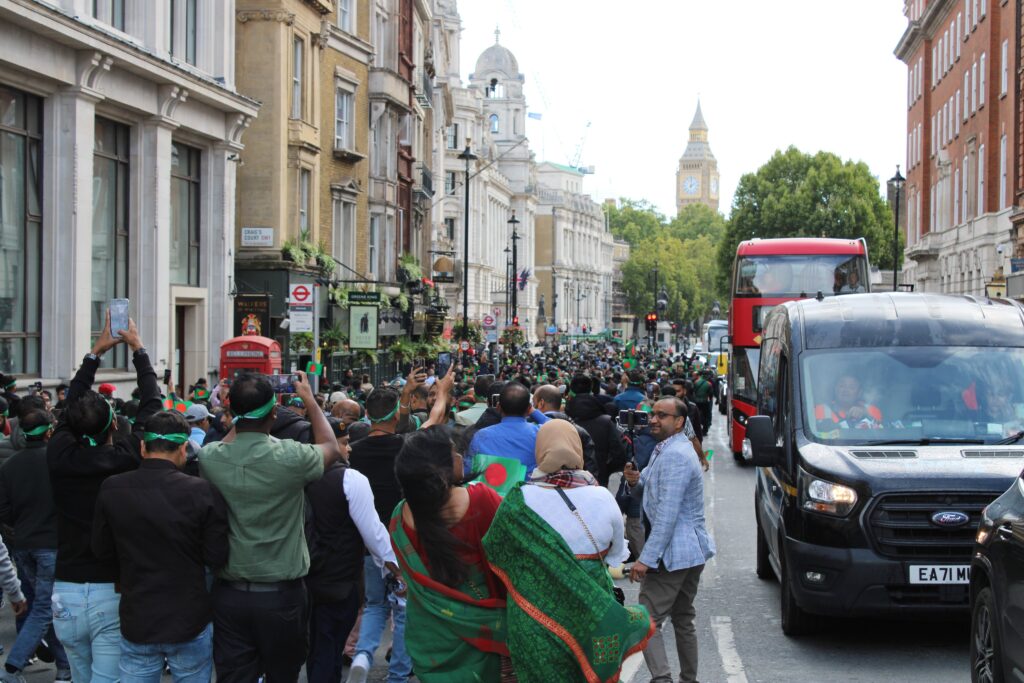
The Awami League, Bangladesh’s oldest political party and a cornerstone of its 1971 liberation struggle, faces an existential crisis. Banned by the Interim Government on charges of alleged links to terrorism, the party’s supporters see this as a politically motivated assault on secularism and pluralism. Against this backdrop, Awami League supporters gathered in London on September 15, 2025, marching from Trafalgar Square to Parliament Square to protest the erosion of democratic values and the rise of extremism in their homeland. Their demonstration underscores a broader battle for Bangladesh’s soul—one that pits the ideals of its founding against a growing tide of radicalism and factionalism.
A Legacy Under Siege: The Spirit of 1971
To understand the stakes, one must revisit Bangladesh’s founding in 1971. Born out of a bloody liberation war against Pakistan, Bangladesh emerged as a secular, democratic state under the leadership of Sheikh Mujibur Rahman and the Awami League. The war, which claimed an estimated 3 million lives and displaced millions more, cemented values of pluralism, gender equality, and social justice as national cornerstones. Yet, today, these principles are under attack. The Interim Government, led by Nobel laureate Muhammad Yunus, has been accused of systematically erasing this legacy. Monuments to 1971, including statues of Sheikh Mujibur Rahman, have been defaced or removed, Liberation War holidays cancelled, and textbooks revised to downplay the Awami League’s role. Sabir Mustafa, writing in Counterpoint, argues that this is a deliberate campaign to hollow out the memory of 1971. For Mustafa, the Interim Government’s actions are not merely political but an assault on Bangladesh’s national identity. If younger generations grow up detached from the spirit of 1971, the values of secularism and pluralism that shaped the nation’s birth could be fatally undermined. This revisionism is particularly alarming given the rise of Islamist groups like Jamaat-e-Islami and Hefazat-e-Islami, whose ideologies clash with the inclusive vision of Bangladesh’s founders.
The Monsoon Uprising and Its Aftermath
The Monsoon Uprising of 2024 began as a student-led protest against the Awami League’s controversial quota system for government jobs, but quickly escalated into a broader anti-government movement. By August, Prime Minister Sheikh Hasina was forced to flee the country, and the Interim Government, led by Yunus, assumed power. What began as a call for reform has descended into chaos. Mob violence has spiralled, with vigilante groups and armed gangs unleashing beatings, assaults, and revenge killings. Reports of sexual violence, including systematic rape targeting women linked to political opponents, have surfaced, evoking memories of the atrocities of 1971. Women athletes, once symbols of national pride, have faced targeted attacks. Bangladesh’s women’s football program, a beacon of female empowerment, has been vilified by extremists who view women’s participation in sports as a threat to their ideology. Indigenous communities, long marginalised, report land seizures, arson, and attacks on their villages. Hindu minorities, numbering around 8% of Bangladesh’s 170 million population, have faced assaults and temple desecrations, with their loyalty to the state questioned in a climate of growing religious intolerance. According to Human Rights Watch, over 1,000 incidents of violence against minorities were reported in the three months following the uprising, though the actual figure is likely higher.
Islamist Ascendancy: Jamaat and Hefazat’s Growing Influence
The rise of Jamaat-e-Islami and Hefazat-e-Islami marks a turning point. Their student wings’ victories at DACSU and JACSU, representing over 50,000 students, have given them legitimacy and a platform to radicalise a new generation. Hefazat leaders’ reported meetings with the Taliban in Kabul in early 2025 signal an alarming ideological alignment. Jamaat, historically linked to war crimes during the 1971 liberation war, has capitalised on the political vacuum, positioning itself as a defender of “Islamic values” against secular governance. Their growing influence raises fears of a theocratic shift, with policies that could roll back women’s rights, minority protections, and democratic freedoms.
The Interim Government’s inaction has fuelled these concerns. Yunus, once hailed for his microfinance innovations, has struggled to govern effectively. Critics point to his adviser, Mahfuj Alam, whose admiration for Mao’s Cultural Revolution has raised eyebrows. Associates of Alam have privately warned of a deliberate effort to erase Bangladesh’s secular heritage, replacing it with a new narrative that accommodates Islamist demands. This passivity, if not complicity, has allowed student radicals to operate with impunity, further destabilising the country.
Factionalism and the BNP’s Implosion
The Bangladesh Nationalist Party (BNP), long seen as the Awami League’s chief rival, is in disarray. Internal factionalism has erupted into violence, with gunfights between rival groups leaving dozens dead in cities like Dhaka and Chittagong. The party’s inability to unite undermines its claim to leadership as elections approach in February 2026. Tarique Rahman, the exiled son of BNP leader Khaleda Zia, remains a polarising figure. Living in London since 2008, Rahman’s reputation for corruption and violence was detailed in leaked U.S. diplomatic cables published by WikiLeaks, which suggested he might be barred from entering the United States. His potential return looms large, with supporters viewing him as a saviour and critics fearing a return to cronyism and instability. The BNP’s internal chaos and Rahman’s controversial legacy make it ill-equipped to counter the Islamist surge or provide a stable alternative to the Interim Government.

Voices from London: A Call for Resilience
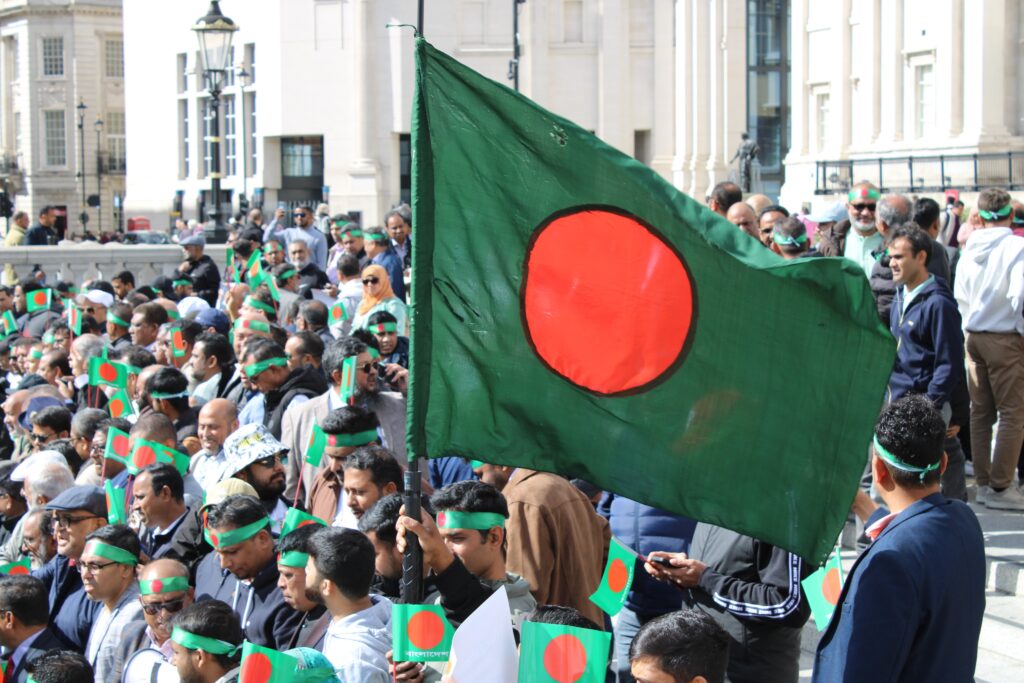
Against this grim backdrop, Awami League supporters rallied in London on September 15, 2025. The march, attended by thousands, was a powerful display of defiance and solidarity. Mifatul Noor, a young Bangladeshi-British woman, emerged as a voice of conviction. Dressed head to toe in Bangladesh’s colours, waving a large Lal Sobuj (Red-Green) flag, and sporting a Bangladesh headband. She was hard to miss in contrast to Trafalgar Square’s natural granite and York stones. “The Awami League is not just a party; it’s a symbol of Bangladesh’s secular, constitutional foundation,” she told the crowd. “It’s the stability our country needs for security and economic growth.”
Noor rejected the Interim Government’s labelling of the Awami League as “fascist.” “This is a smear to silence us,” she said. “Fascism thrives on strength and victimises the weak. The Awami League respects the constitution, champions free elections, and protects women and minorities. That’s the opposite of fascism.” Her words resonated with the crowd, particularly young women who see the Awami League’s legacy of gender empowerment—evidenced by Bangladesh’s rise to second place in South Asia on the Gender Parity Index under Sheikh Hasina—as under threat.
Noor highlighted the party’s achievements, including lifting 25 million people out of poverty between 2008 and 2024, according to World Bank data, and advancing women’s education and economic participation. She warned that Islamist consolidation could reverse these gains, citing rising attacks on women and minorities. “The Awami League worked tirelessly for a rules-based order, protecting Hindus, indigenous groups, and even the Rohingya,” she said. “The Yunus administration has abandoned this vision, leaving minorities vulnerable.“
Men at the march echoed her concerns. “We cannot let radicals destroy our daughters’ futures,” one father said, reflecting widespread fears of a rollback in women’s rights. Another protester criticised Tarique Rahman, referencing his tarnished reputation. “His corruption and violence are well-documented,” he said, pointing to the WikiLeaks cables. For these supporters, the Awami League represents a bulwark against both Islamist extremism and the BNP’s dysfunction.
As I shuffled through the thousands that had made it to Parliament Square, I managed to talk to Syed Faruk Rahman, the General Secretary of the Awami League UK. I bumped into him as he was being interviewed by a Bangladeshi news channels. After he finished talking I managed to steal a few words from him. The first thing he said to me was, “Who else could get this kind of following on a Monday afternoon?” It was a good point. Bangladeshis had taken over Whitehall. Pictures of Sheikh Hasina and Bangabandhu were proudly displayed. Flags that were large enough to cover national monuments. It was a carnival. People weren’t angry despite pictures of Yunus accusing him of numerous crimes, but people were caught between fear and being cautiously optimistic. It’s clear the Awami League are still committed to politics in the UK and Bangladesh. Many believe in reform, but not the way Yunus has packaged it. There is still a lot of anger directed at the Awami League in Bangladesh. It’s something that they will have to navigate as they try to push for inclusion.
A few British politicians and their staff had come over to talk to the demonstrators to ask about their cause. I overheard them talking about Yunus. Disappointment was used numerous times. I was earwigging, and couldn’t resist.
A Personal Reflection: The Cost of Silence
Having followed Bangladesh’s politics for over two decades, I reject claims that my focus on the Awami League makes me “anti-Bangladesh” or not “pro-Bangladesh.” Kawsar Chowdhury, Co-Chairman of the Bangladesh America Alliance, expressed his displeasure on X, Elon Musk’s social media platform, about my coverage of the demonstration. Back in 2006, I organized a conference in London with the Policy Exchange, Hudson Institute, The New Statesman, and the International Bangladesh Foundation, gathering representatives from major parties, including the Awami League and BNP. UK politicians like Charles Tannock, Lord Avebury, and Jeremy Corbyn joined forces, calling to end political violence in Bangladesh. I encouraged Bangladeshi politicians to learn from them—British politicians of all spots and stripes working together to create a better political landscape. I advocated for a stronger Sangsad (parliament) and inclusive politics, a vision that feels distant under the Interim Government’s weak leadership. The arrest of Shahriar Kabir, a prominent human rights activist and acting president of the Forum for Secular Bangladesh, highlights this troubling drift. Jailed on trumped-up charges in 2025, Kabir’s fate reflects the Interim Government’s willingness to appease Islamists who have long targeted him. His imprisonment, alongside the silencing of other secular voices, underscores the urgency of the moment.
The Road to February: A Defining Moment
As Bangladesh approaches elections in February 2026, the stakes could not be higher. The BNP’s internal strife renders it an unreliable force. Jamaat and Hefazat’s gains threaten a theocratic shift. The Awami League, though banned, commands the loyalty of tens of millions, with 40% of voters supporting it in pre-ban polls by the Bangladesh Institute of Peace and Security Studies. The Interim Government’s legitimacy is waning, with public approval dropping to 32% in a September 2025 survey by Prothom Alo, down from 60% in August 2024. The fairness of the elections is in doubt. Noor emphasised the need for a transparent process: “Accountability comes through the ballot box, not kangaroo courts like the International Crimes Tribunal, controlled by Yunus’s regime. A rigged election that excludes Awami League supporters betrays democracy.” The international community, including the UN and Western governments, has called for free and fair elections, but their influence remains limited.
Conclusion: A Fight for Bangladesh’s Future
The London rally was more than a protest; it was a reminder that Bangladesh’s diaspora refuses to let their nation’s history be erased. The Awami League’s supporters, both in Bangladesh and abroad, see themselves as guardians of the 1971 vision—a secular, pluralistic, and democratic state. As violence escalates and extremists gain ground, their resilience offers hope amid uncertainty. Bangladesh stands at a crossroads. The February elections will not only determine who governs but also whether the ideals of 1971 can endure. The voices in London, from Mifatul Noor to the fathers and mothers marching alongside her, are a clarion call: the fight for Bangladesh’s soul is far from over. The world must watch closely, for the outcome will shape not just Bangladesh but the broader struggle between democracy and extremism in South Asia.