
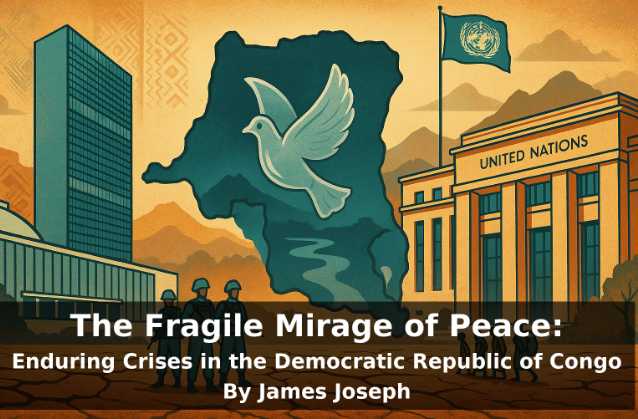
The Democratic Republic of Congo (DRC), a nation blessed with unparalleled natural wealth, remains trapped in a vortex of violence, exploitation, and despair. At present, the eastern provinces continue to bleed from conflicts that have displaced millions and claimed countless lives. The recent US-brokered peace deal between the DRC and Rwanda, signed on 27th June 2025, was hailed as a breakthrough, promising troop withdrawals and security coordination. Yet, mere weeks later, armed militias slaughtered hundreds in fresh attacks, underscoring the stark reality of the deal’s fragility. In this context, I delve into the intertwined issues of security, politics, human rights, peace-building efforts, and the controversial peace accord brokered by USA.
To contextualise these crises, a timeline of the eastern DRC conflict highlights its deep roots and recent escalations. Whilst the deal offers a sliver of hope, it risks perpetuating injustice by prioritising mineral access over genuine reconciliation, leaving the Congolese people—the ordinary civilians, as in most conflicts—to pay the price. Understanding the conflict requires tracing its evolution. The roots of the Democratic Republic of Congo’s (DRC) eastern conflict trace back to 1994, when the Rwandan genocide concluded, triggering an influx of over a million Hutu refugees—including perpetrators of the genocide—into what was then Zaire. This mass migration sowed the seeds of cross-border tensions that erupted into the First Congo War from 1996 to 1997, during which Rwanda and Uganda invaded to dismantle Hutu militias, ultimately overthrowing dictator Mobutu Sese Seko and installing Laurent Kabila as president. The fragile aftermath gave way to the Second Congo War from 1998 to 2003, often dubbed Africa’s World War, as it drew in nine countries and resulted in millions of deaths, primarily from disease and starvation, amid rampant resource exploitation and the persistence of ethnic militias that continue to plague the region.
Post-war tensions boiled over in 2004 with the eruption of the Kivu conflict, pitting Congolese forces (FARDC) against Hutu Power groups like the Democratic Forces for the Liberation of Rwanda (FDLR), whilst Rwanda faced accusations of backing Tutsi militias to protect its interests. This cycle intensified with the formation of the M23 rebellion in 2012–2013, a group of army defectors claiming to defend Tutsi minorities; backed by Rwanda, M23 briefly captured Goma before being defeated by UN and Congolese forces.
The March 23 Movement, or M23, takes its name from a peace agreement signed on 23rd March 2009 between the Congolese government and an earlier Tutsi-led rebel group, the CNDP. Its leaders accused Kinshasa of failing to honour that deal, particularly the integration of their fighters into the national army. Predominantly Tutsi and drawing support from the Banyamulenge community, M23 presents itself as a defender of minority rights but has been repeatedly accused by the UN of receiving military backing from Rwanda—a charge Kigali denies. Since its emergence, M23 has become notorious for atrocities including massacres, forced displacement, child recruitment, and systematic sexual violence, placing it at the heart of both the region’s instability and international concern.
Yet, the rebellion resurfaced in 2021–2022 amid stalled disarmament efforts, advancing near Goma by November 2022 and displacing hundreds of thousands whilst committing documented atrocities.
The conflict escalated dramatically in late 2024, as M23 launched major advances beyond its previous strongholds, intensifying fighting across North and South Kivu provinces. By January 2025, M23 initiated a full offensive on Goma, capturing Goma, the North Kivu capital, between 23rd and 30th January, displacing over 500,000 people in one of the most severe humanitarian crises in recent years. In February 2025, M23 declared a unilateral humanitarian ceasefire on 4th February, though clashes resumed soon after in South Kivu, allowing further territorial gains. The momentum continued into March 2025, with M23 seizing the Walikale mining hub on 19th March—its farthest western reach—exacerbating the ongoing humanitarian disaster tied to control over mineral-rich areas. A potential turning point arrived on 27th June 2025, when the US-brokered peace deal was signed between the DRC and Rwanda, aiming to end hostilities through troop withdrawals and joint security measures. Progress followed with the first joint security mechanism meeting on 1st August 2025, where DRC and Rwanda outlined an initial economic framework.
Additional security meetings and reviews occurred from 7th to 11th August 2025, though violence persisted, with reports of ongoing M23 killings highlighting the deal’s fragility. This timeline reveals a persistent pattern: foreign interventions, deep-seated ethnic grievances, and insatiable greed for resources have perpetuated a war that has claimed over six million lives since 1996, demanding urgent, genuine international commitment beyond superficial accords.
The security situation in the DRC is a powder keg that defies easy resolution. Eastern provinces like North Kivu, South Kivu, and Ituri are battlegrounds for over 100 armed groups, including the Rwanda-backed M23 rebels, the Allied Democratic Forces (ADF), and local militias. In early 2025, M23 intensified its offensive, capturing key towns like Goma in a brutal campaign that echoed the horrors of past decades. Despite the June peace agreement, which mandates Rwandan troop withdrawal within 90 days and establishes a joint security mechanism, violence has surged. UN reports from August 2025 detail indiscriminate killings, with at least 319 civilians recently killed by M23 fighters.
The humanitarian toll is staggering: 27 million people need aid, with displacement camps overflowing and basic services collapsed. Resource exploitation fuels this chaos—coltan, gold, and cobalt mines are contested prizes, drawing foreign interests, and perpetuating a cycle of war. The peace deal’s implementation, including meetings through 11th August 2025, is a step forward, but ongoing M23 advances reveal its limitations. Without robust enforcement, including UN-backed disarmament, the DRC’s security remains illusory.
Politically, the DRC teeters under President Félix Tshisekedi’s second term, inaugurated in January 2024 after a contentious election where he secured over 70% of votes amid opposition cries of fraud. Tshisekedi’s administration has grappled with eastern instability, imposing martial law in North Kivu and Ituri, which has only facilitated further abuses. Efforts to form a “government of national unity” in February 2025 faltered as military strategies collapsed against M23’s resurgence. Corruption scandals and resource mismanagement erode public trust, whilst regional tensions with Rwanda exacerbate internal divisions. Tshisekedi’s engagement in the US-Qatar-mediated talks signals diplomatic savvy, but critics argue it concedes Congolese sovereignty for foreign aid. The political climate is one of fragile alliances and simmering unrest, where protests in Kinshasa over eastern fighting turned violent in January 2025. True stability demands electoral reforms and inclusive governance, not just ceasefires that mask deeper fractures.
Human rights violations in the DRC are systemic and horrifying, potentially amounting to war crimes as per UN assessments. Government forces, rebels, and militias commit unlawful killings, disappearances, and property destruction with impunity. In 2025 alone, over 100 civilians died from indiscriminate shelling, and hundreds were extrajudicially executed by state actors. Human Rights Watch has documented abuses under martial law, including arbitrary detentions and torture. The peace deal’s failure to address accountability—ignoring calls for investigations into crimes since 2022—risks entrenching a culture of impunity. Defenders face extreme risks, with eastern activists targeted amid escalating violence. International pressure must prioritise justice mechanisms, like ICC probes, to break this cycle.
Marginalised groups, particularly the Banyamulenge—a Tutsi minority in South Kivu—endure existential threats. Labelled as “foreign invaders” despite centuries-old roots, they face genocidal violence from militias and government-backed forces. In 2025, attacks in Hauts Plateaux regions intensified, with massacres echoing historical pogroms. M23 claims to protect them, but this rhetoric fuels broader conflict. Other groups suffer displacement and resource dispossession. The peace deal’s economic framework overlooks these vulnerabilities, potentially exacerbating discrimination. Inclusion of marginalised voices in negotiations is essential for sustainable peace.
Women bear the brunt of the DRC’s turmoil, yet they are pivotal to peace and security. Conflict-related sexual violence spiked 270% in early 2025, with thousands raped as a weapon of war. UN Resolution 1325’s National Action Plan aims to empower women, but implementation lags amid patriarchal barriers. In Kasai, over 200 women mediate disputes and rebuild communities, demonstrating grassroots resilience. The August 2025 Security Council debate on conflict-related sexual violence highlighted the need for gendered approaches. Integrating women into peace processes isn’t optional—it’s imperative for holistic security.
The US-brokered peace deal, formally titled the Peace Agreement Between the Democratic Republic of the Congo and the Republic of Rwanda, was signed in Washington on 27th June 2025, under President Trump’s auspices. Mediated by the US and Qatar, it intertwines geopolitics with resource grabs, committing both nations to UN resolutions, troop disengagement, and economic integration. Key provisions include Rwanda’s withdrawal of forces within 90 days, the establishment of a joint security coordination mechanism within 30 days, and de-risking mineral supply chains to attract foreign investment. Trump openly touted securing “a lot of the mineral rights,” positioning the US to diversify critical supplies like cobalt and tantalum away from China.
By 2nd August 2025, an economic framework outline was agreed upon, paving the way for value chains linking DRC and Rwanda. The first joint security meeting occurred on 1st August 2025, followed by sessions on 7th August and reviews by 11th August amid US-backed regional efforts. However, the deal faces fierce criticism: Congolese activists decry it as “selling the country,” accusing Tshisekedi of trading sovereignty for aid, whilst experts warn it ignores root causes like ethnic tensions and impunity. House Democrats in the US seek transparency over mineral talks, fearing neo-colonial overtones.
Despite attracting investments, ongoing clashes—such as M23’s advances post-signing—render it fragile, with PolitiFact noting Trump’s role in temporary ceasefires but emphasising their shakiness. For success, the accord must evolve to include justice, demobilisation of all militias, and equitable resource sharing, rather than prioritising extraction.
In effect, the DRC’s multitude of crises is not inevitable but a product of neglect by governing forces, war, and exploitation. The US-brokered deal offers a framework, but without addressing root causes—security vacuums, political exclusion, rights abuses, marginalisation, and gender inequities—it risks collapse. The international community must demand accountability, empower local actors, and prioritise people over profits. Only then can the Congolese reclaim their future from the shadows of war.


1 Comment