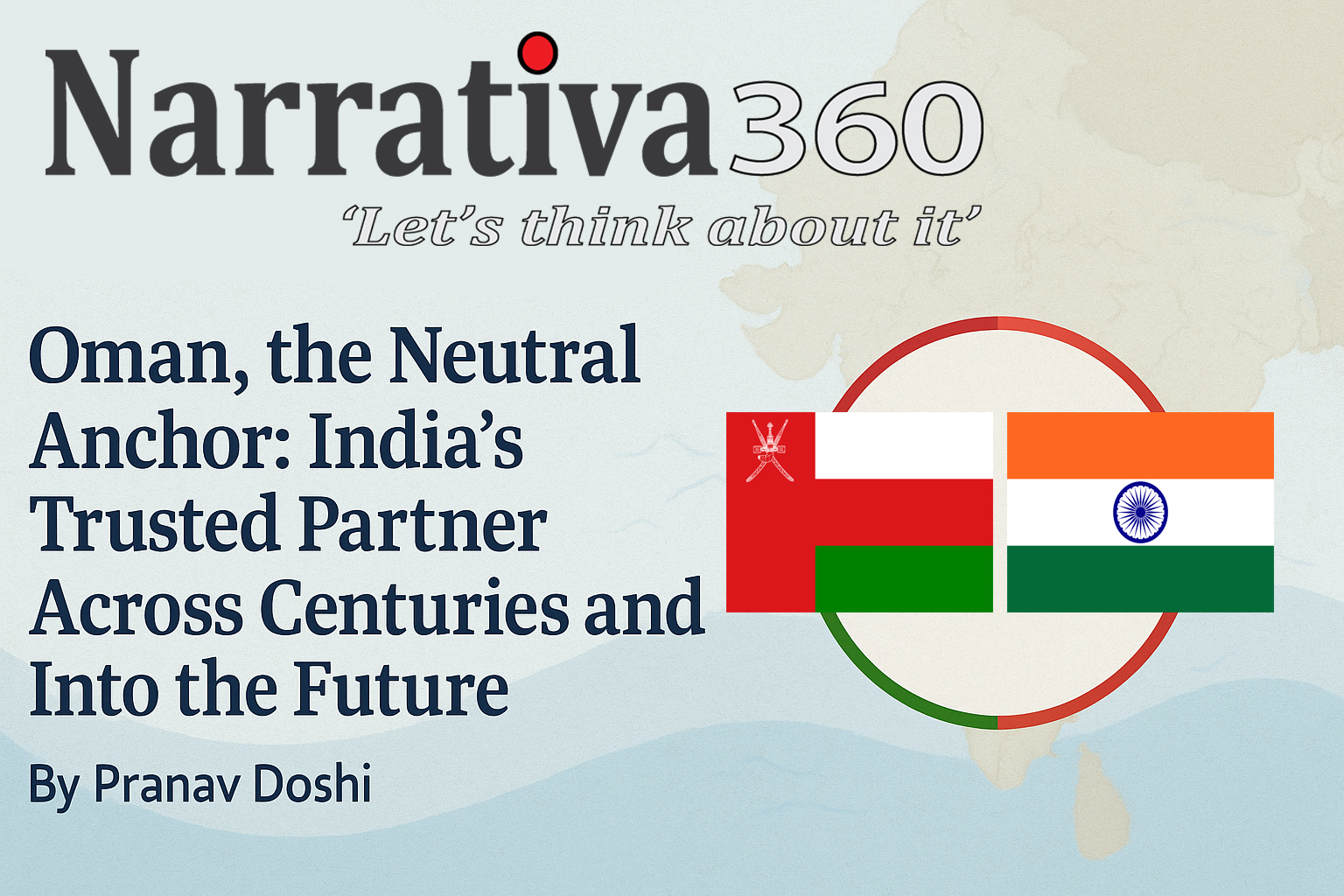
More than four centuries ago, Gujarati merchants set sail from India to Oman, carrying textiles, rice, and spices across the Arabian Sea. What began as commerce grew into trust—and that trust, quietly nurtured over generations, now underpins India’s maritime strategy in a region where ports are as powerful as armies.
A Constant in a Shifting Gulf
Long before the rise of the United Arab Emirates or Saudi Arabia as Gulf powerhouses, Oman had already carved its role as a rare constant in the shifting politics of the Arabian Peninsula. For India, Oman has never been just a neighbour across the Arabian Sea—it has been a neutral harbour for trade, diplomacy, and maritime security. This relationship was not born of convenience; it was constructed voyage by voyage, community by community, until it became one of India’s most enduring partnerships.
The Gujarati Link
The bedrock of this relationship lies in the journeys of Gujarati traders who carried rice, spices, and textiles to Muscat and returned with dates, frankincense, and Arabian horses. These communities were more than merchants: they became financiers, advisers, and even civil servants, embedding themselves in Omani society. Indian rupees circulated widely, Indian sepoys guarded Omani ports, and Indian professionals taught in schools and helped modernise Muscat. Gujarati families intermarried, festivals spread, cuisine blended—creating a social fabric that India could always lean on when regional dynamics grew unpredictable.
Oman’s Indian Ocean Empire
Indian engagement with Oman was not confined to Muscat. During the 17th to 19th centuries, when Oman extended its maritime empire to East Africa, Indian merchants, clerks, and financiers accompanied Omani rulers to Zanzibar, Mombasa, and Dar es Salaam. Gujarati trading families became vital to the Omani economy in East Africa, managing customs houses, financing trade, and supplying goods from the subcontinent. Indian textiles, rice, and beads were exchanged for African ivory, cloves, and labour, creating a triangular economic network that tied Gujarat, Muscat, and Zanzibar together. This broader canvas demonstrates that Indo-Omani cooperation was not merely bilateral but part of a larger Indian Ocean system in which both sides relied on each other to thrive.
Colonial-Era Collaboration
Under British colonial rule, the Indian connection to Oman only deepened. Indian rupees became the currency of daily life in Muscat until the 20th century, while Indian sepoys were stationed in Omani ports to provide security. Many Omani officials depended on Indian clerks, doctors, and engineers for administration and modernisation. In Muscat, the Gujarati Hindu and Bohra Muslim communities acted as intermediaries not only between Oman and India but also with the British authorities. These roles strengthened a tradition of trust that survived the turbulence of empire and the transition to independence.
Oman after Independence
When India achieved independence in 1947, Oman continued to value this relationship. In 1971, it became the first Gulf country to sign a formal friendship treaty with India, just as Britain announced its withdrawal from “east of Suez.” For Oman, India was a natural partner, historically reliable and geographically proximate. During the Dhofar Rebellion of the 1960s and 1970s, India refrained from direct military involvement. Still, Indian doctors, contractors, and expatriates quietly helped sustain the Omani state’s capacity at a time of significant instability. Indian naval goodwill visits began in this period, laying the groundwork for the naval exercises that later became institutionalised as Naseem al-Bahr in the 1990s.
The Gwadar Episode
History sometimes presents opportunities disguised as burdens. Gwadar, an Omani enclave until 1958, was one such case. Sultan Said bin Taimur quietly offered the port to India in the 1950s. At the time, India—reeling from Partition, economic scarcity, and an ideological commitment to non-alignment—chose to decline. Gwadar appeared barren and impractical. In hindsight, it was a costly hesitation. Pakistan purchased the port for just three million dollars, and decades later, China transformed Gwadar into a strategic node of its Belt and Road Initiative. For Beijing, it offers direct access to the Arabian Sea, bypassing the Malacca Strait; for India, it represents a persistent vulnerability on its western flank.
Duqm: The Opportunity Seized
History, however, rarely shuts doors without opening others. In 2018, India secured access to Oman’s port of Duqm, located on the Arabian Sea outside the Strait of Hormuz. Unlike Gwadar, Duqm symbolises openness. Oman’s neutrality has made the port a hub for logistics, repairs, and joint exercises—extending India’s reach into the western Indian Ocean without the burden of territorial ownership. Duqm reflects the sophistication of Oman’s diplomacy. Muscat speaks to Tehran while hosting American forces, engages Beijing while keeping its doors open to New Delhi. For India, this means access without entanglement—a strategic counterbalance to China’s “string of pearls” across the Indo-Pacific.
Defence and Security Cooperation
Today, strategic alignment is being reinforced through multi-domain engagements. In September 2024, India and Oman concluded their biennial army exercise Al Najah-5, showcasing capability in desert warfare, counter-drone operations, and joint tactical planning. The Indian and Omani air forces continue to build interoperability through the Eastern Bridge series at Masirah Air Base. At the same time, naval collaboration remains long-standing, with Naseem al-Bahr marking over 30 years of maritime cooperation. Oman is the only Gulf state that conducts regular exercises with all three branches of the Indian armed forces, a reflection of deep trust and alignment.
Economic Diplomacy and People-to-People Links
Economic diplomacy is also gaining momentum. A Comprehensive Economic Partnership Agreement (CEPA) is close to being finalised, signalling a new chapter in bilateral trade and investment. In May 2025, India and Oman also updated their Double Taxation Avoidance Agreement, expanding provisions to include digital and service-based operations while reducing withholding taxes. These changes will smooth business and professional exchanges, paving the way for stronger private-sector engagement across the corridor.
Alongside state-to-state ties, people-to-people links remain vital. Around 700,000 Indians live and work in Oman, the largest expatriate community in the country. Unlike some Gulf states, Oman has generally treated its Indian workforce with dignity, allowing religious freedoms and providing legal protections. This has reinforced India’s perception of Oman as a partner whose reliability extends beyond politics into society itself.
Diplomacy and Culture
Diplomatic and cultural relations are also being revitalised. In February 2025, External Affairs Minister Dr. S. Jaishankar delivered the keynote address at the 8th Indian Ocean Conference in Muscat, highlighting India and Oman’s shared maritime priorities. The same month, the two nations celebrated 70 years of diplomatic ties through cultural events in Delhi, including a symposium at Jamia Millia Islamia and a records exhibition showcasing the depth of India–Oman connections. An Omani delegation from the Public Authority for Special Economic Zones and Free Zones (OPAZ) visited India to engage business leaders on new investment opportunities. Additionally, Oman launched a tourism campaign in India in August 2025, which connected with more than 150 travel companies.
Ports as Instruments of Influence
The dual stories of Gwadar and Duqm illuminate a broader truth: ports are not simply infrastructure, but instruments of influence. For decades, India’s strategic mindset was continental, obsessed with land borders, while the seas remained peripheral. Gwadar’s rejection was born of that outlook. Today, doctrines like SAGAR—Security and Growth for All in the Region—show how far the pendulum has swung. Access agreements now carry more weight than ownership; presence is power. Equally important is the role of human networks. Centuries of Gujarati engagement gave India a reservoir of trust to draw upon in Muscat—something that pure military power could never replicate. Oman’s posture as a regional balancer amplifies that advantage.
Looking Ahead
India’s partnership with Oman is both a blueprint and a warning. Gwadar reminds New Delhi of the costs of short-term thinking; Duqm demonstrates the value of foresight, patience, and trust. As India seeks to navigate a contested Indo-Pacific, ports like Duqm will be more than refuelling stations—they will be symbols of enduring partnership. Oman’s neutrality, coupled with the deep cultural and commercial ties forged by Gujarati traders, offers India a rare model of stability in a volatile region. The challenge now is sustaining this long game—projecting power without arrogance, anchoring trust without complacency, and ensuring that centuries of shared history remain a compass for India’s maritime future.